

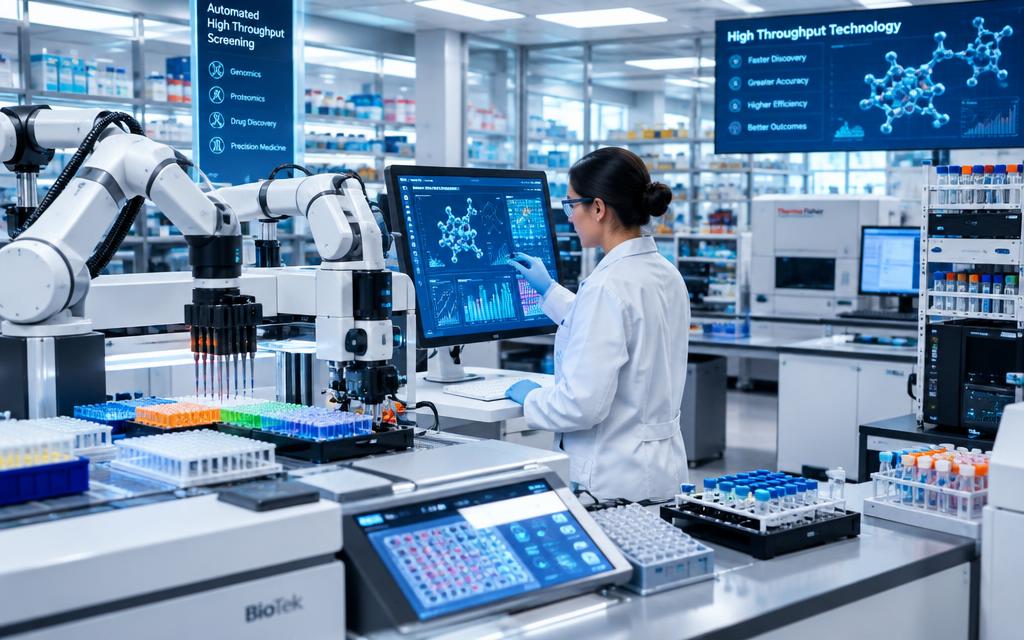
What is high throughput technology? The high throughput technology definition describes fast, efficient processing of many samples or data points in research, healthcare, and manufacturing. Automation and parallel processing help high-throughput systems enable scientists and engineers to run experiments and analyses beyond traditional methods.
A high throughput process miniaturizes workflows and creates standard procedures that improve productivity. Unlike simply raising speed or volume, it optimizes work for reliable results in less time. This approach has major effects on pharmaceutical research and materials science.
This article explains how high-throughput systems work and defines their main uses. It explores real-world applications and major benefits, including advances in genomics and molecular biology. Understanding these systems helps professionals use their potential effectively.
Key Takeaways
- High throughput enables rapid processing of numerous samples.
- Automation and parallel processing are essential components.
- This technology improves productivity in various industries.
- Applications include pharmaceutical research and materials science.
- Standardized workflows enhance reliability and efficiency.
What Is High Throughput Technology?
High throughput technology marks a major change in laboratory work. This integrated approach improves efficiency while letting researchers perform many operations or analyses at once or in quick succession. It combines automated instruments, robotics, specialized plates or cartridges, sensitive detection systems, software, and automated research technology for data processing.
To understand high throughput technology, compare it with traditional laboratory methods. Traditional workflows use sequential steps, larger sample volumes, and manual transfers. High throughput screening raises capacity through parallel work and standard procedures, but it does not ensure better results. Experimental design, controls, assay quality, instrument calibration, and data interpretation remain vital.
Defining High Throughput Technology
The high throughput definition describes a set of technologies for rapid sample analysis. These technologies support many applications, from drug discovery to genomics. Automation and parallel processing help researchers handle vast amounts of data efficiently.
How High Throughput Differs from Traditional Methods
The main difference between high throughput and traditional laboratory methods involves the scale and speed of operations. Traditional methods use manual steps and smaller sample sizes, making them slower and less efficient. High throughput techniques process multiple samples at once, greatly reducing analysis time.
Historical Development and Evolution
The evolution of high throughput technology has changed laboratory practices over the years. Research first relied on manual techniques, but automated screening and microplate-based assays brought major progress. Later, microfluidics and next-generation sequencing led to cloud-enabled analysis and more integrated platforms.
| Aspect | Traditional Methods | High Throughput Technology |
|---|---|---|
| Sample Handling | Sequential | Parallel |
| Processing Speed | Slow | Rapid |
| Sample Volume | Larger | Smaller |
| Automation Level | Low | High |
Core Principles Behind High Throughput Technology
High throughput technology uses key principles to improve research speed and efficiency. These principles help teams optimize workflows in many research settings. The three core principles are automation and parallel processing, miniaturization in research, and data integration.
Related Posts:
- What Are the Applications of Information Technology?…

- What Is EHR Technology Electronic Health Records Explained

- What Is Polymer Technology The Science of Plastics…
- The Latest Technology Trends Shaping Our Future

- How Technology Can Help Fight Climate Change Green…

- An Example of Manufacturing Technology 3D Printing…
Automation and Parallel Processing
Automation and parallel processing increase throughput in research. Robotic systems and programmable instruments move samples with precision. Multiwell plates and multiplexed assays process many samples at once, reducing repetitive manual steps.
This approach increases capacity and reduces human error. By analyzing many samples at once, researchers can study several variables in one experiment. This streamlined workflow produces faster results and uses resources more efficiently.
Miniaturization and Microfluidics
Miniaturization in research supports high throughput workflows. Smaller reaction volumes use less reagent and shorten reaction times, allowing many conditions to be tested at once. Microfluidics technology controls tiny fluid volumes as they move through channels and droplets.
Effective fluid control helps prevent contamination and supports accurate results. With microfluidics, researchers can run complex experiments using minimal sample sizes. This further improves workflow efficiency.
Data Integration and Real-Time Analysis
Data integration and real-time data analysis help researchers understand large datasets from high throughput workflows. Instruments produce large datasets that need careful capture, normalization, and quality checks. Laboratory information management systems (LIMS) and analytics software organize data and keep it accessible.
Real-time feedback helps researchers make quick, informed decisions and improve experiment efficiency. These principles work together: automation increases throughput, miniaturization makes scaling economical, and data systems turn output into actionable insights. This connection shows why high throughput technology needs a cohesive approach.
Key Components and Techniques
High throughput technology uses key tools and methods to improve laboratory efficiency and accuracy. These elements matter to research and development teams. They include robotic systems, detection tools, and software for high throughput work.
Robotic Systems and Liquid Handling
Robotic systems support laboratory automation, especially robotic liquid handling. They perform repeated tasks precisely, which improves consistency and lowers human error. Key features of robotic liquid handling systems include:
- Automated Pipetting: Enables precise volume transfers across various plate formats.
- Plate Movers: Efficiently transport samples between different instruments.
- Dispensers and Incubators: Facilitate controlled environments for reactions.
- Calibration and Tip Management: Ensures accuracy and prevents cross-contamination.
These examples show common robotic screening platforms:
Examples of Robotic Platforms in Use
- Automated liquid handlers from Hamilton and Tecan.
- Integrated screening workstations from Beckman Coulter Life Sciences.
- Modular robotic cells from Thermo Fisher Scientific.
Detection and Imaging Technologies
High throughput detection systems measure signals such as fluorescence, luminescence, and absorbance. They help researchers extract useful data from experiments. High-content analysis and imaging help researchers:
- Analyze multiple features from each sample.
- Gather morphological and molecular sequence data.
- Enhance the understanding of biological processes.
Software and Data Management Platforms
Software solutions support scientific data management and manage the vast data generated in high throughput environments. These platforms support instrument control, workflow scheduling, sample tracking, and a laboratory information management system:
- Instrument Control: Streamlines the operation of various laboratory instruments.
- Workflow Scheduling: Optimizes the sequence of tasks to enhance efficiency.
- Sample Tracking: Ensures accurate monitoring of samples throughout the process.
- Laboratory Information Management Systems (LIMS): Facilitates data normalization and audit trails.
Interoperability and data integrity matter because fast instruments have value only when results can be traced and reproduced. For more information on laboratory data management, visit this resource.
Applications in Pharmaceutical Research
Pharmaceutical research technology is changing pharmaceutical research. It improves the efficiency and effectiveness of work from drug discovery through clinical trials. Researchers can study vast amounts of data quickly to develop new therapies and treatments.
Drug Discovery and Compound Screening
Compound screening tests large libraries against biological targets, cells, enzymes, or disease models. High throughput screening in drug development supports this work through primary screens, confirmatory assays, dosage-response testing, and hit validation.
- Primary screens to identify potential drug candidates.
- Confirmatory assays to validate initial findings.
- Dosage-response testing to determine the efficacy of candidates.
- Hit validation to ensure the biological relevance of results.
Researchers must account for false positives and assay interference, which can skew results. Rigorous validation ensures findings accurately guide development decisions.
Clinical Trial Optimization
High throughput technology also supports clinical trial optimization. By processing high volumes of data, it supports patient stratification, biomarker analysis, sample logistics, and protocol monitoring.
- Patient stratification to identify suitable candidates for trials.
- Biomarker analysis to understand patient responses.
- Sample logistics to manage trial materials efficiently.
- Protocol monitoring to ensure adherence to study guidelines.
These tools improve operational visibility and analytical capacity. However, they do not replace clinical judgment or regulatory oversight.
Toxicity Testing and Safety Assessment
For toxicity testing and safety assessment, high throughput technology uses advanced methods. These include high-content cellular assays, organoid models, and molecular profiling.
- High-content cellular assays to evaluate drug effects on cells.
- Organoid models that mimic human tissues for more accurate results.
- Molecular profiling to identify potential toxicity signals.
Testing multiple endpoints, tissues, or concentrations in parallel makes findings more reliable. This broad approach helps researchers find toxicity signals early in development.
| Application | Methodology | Benefits |
|---|---|---|
| Drug Discovery | Compound Screening | Identifies potential drug candidates quickly |
| Clinical Trials | Data Analysis | Improves patient selection and trial efficiency |
| Toxicity Testing | High-Content Assays | Enhances safety assessments before human trials |
In summary, high throughput technology shortens discovery cycles and increases the number of candidates evaluated. Still, rigorous validation ensures results accurately guide development decisions.
Applications in Genomics and Molecular Biology
High throughput technology has changed genomics and molecular biology. It lets scientists study life’s molecular complexity with greater speed and scale. This section covers genomics technology, DNA sequencing, proteomics, and CRISPR gene editing.
DNA Sequencing and Genomic Analysis
High throughput DNA sequencing has changed genomic analysis by helping researchers study large genetic data sets quickly and accurately. Automated library preparation and massively parallel sequencing process many samples at once. Barcode-based multiplexing also lets researchers study several genomic regions in one run.
Applications include variant detection, gene expression analysis, population studies, and pathogen surveillance. Success depends on coverage, read quality, alignment, and interpretation. Experts note, “The true power of genomics technology lies in extracting meaningful insights from data.”
Proteomics and Biomarker Discovery
In proteomics, high throughput methods support biomarker discovery. Mass spectrometry and antibody-based assays measure many proteins at once, revealing signatures linked to disease or treatment response. Statistical analysis helps ensure these findings are reliable and relevant.
Independent validation is essential for confirming these findings. Researchers must also watch for batch effects that may change results. High throughput technology speeds proteomics research and reveals complex biological processes more efficiently.
CRISPR and Gene Editing Applications
CRISPR technology is a powerful gene-editing tool, and CRISPR screening expands its potential. Pooled or arrayed screens test many gene changes at once, helping identify genes tied to traits or drug responses. Effective guide design and delivery methods are critical for successful experiments.
Sequencing-based readouts assess off-target effects, helping ensure accurate gene editing applications. Follow-up experiments must validate early findings because high throughput expands testing but cannot replace biological interpretation or ethical oversight.
Applications in Materials Science and Manufacturing
High throughput technology has changed materials science applications and manufacturing through rapid material exploration and testing. It speeds discovery and improves new materials for many industrial uses.
One major use is combinatorial materials discovery. Researchers build large libraries with varied compositions, formulations, and processing conditions. Automated deposition and rapid synthesis enable parallel characterization, so scientists can compare strength, conductivity, and corrosion resistance. Screening many materials at once speeds innovation and shortens the path to market.
Combinatorial Materials Discovery
In combinatorial materials discovery, researchers explore many material combinations to find the best candidates for specific uses. With high throughput materials screening, researchers vary chemical composition and processing conditions in a planned way. This method speeds discovery and reveals links between material properties and their underlying structures.
Additive Manufacturing and 3D Printing
Additive manufacturing, commonly called 3D printing, is another field where high throughput technology plays a key role. Automated experiments with different feedstocks, print parameters, and geometries support rapid prototyping and production. Manufacturers can map process-property relationships to optimize production and improve material performance while addressing scale-up and batch consistency.
Quality Control and Industrial Testing
Quality control is vital in manufacturing, and high throughput technology strengthens it through automated testing. Machine vision and sensor-based monitoring enable frequent, standardized inspections that find defects and process drift early. Using statistical process control, these methods improve quality and efficiency, reduce waste, and ensure traceability across batches.
| Application | Technique | Benefits |
|---|---|---|
| Combinatorial Materials Discovery | Automated Synthesis | Faster identification of optimal materials |
| Additive Manufacturing | 3D Printing | Rapid prototyping and production |
| Quality Control | Automated Testing | Improved consistency and reduced waste |
Key Benefits of High Throughput Technology
The benefits of high throughput technology can improve research efficiency. Automation and parallel processing deliver faster results, lower costs, and better data quality. These gains support high throughput methods and scalable experimentation across many scientific fields.
Accelerated Research Timelines
A key benefit is the accelerated research timelines. Automation runs repetitive experiments quickly, so researchers can screen larger libraries in less time. Faster results matter in fields such as drug discovery and materials science.
Cost Efficiency and Resource Optimization
High throughput technology supports cost efficiency and resource optimization. Miniaturization reduces reagent use per sample, which lowers costs and minimizes waste. Automation also reduces manual work, allowing researchers to focus on more critical tasks.
Enhanced Data Quality and Reproducibility
Another advantage is enhanced data quality and research reproducibility. Consistent sample handling and integrated controls reduce variability. Researchers can trust their data more, supporting better decisions and more reliable outcomes.
In conclusion, these benefits extend beyond efficiency. They include accelerated research, cost savings, and improved data integrity. These gains show why modern research settings value these technologies; for further insights into technology trends, visit this link.
Challenges and Limitations to Consider
High throughput technology offers benefits, but it also creates high throughput technology challenges. Organizations must address these barriers before implementation. Knowing the limits supports informed decisions.
High Initial Investment Costs
One major concern is implementation costs for high throughput technology. These costs include:
- Robotic systems and specialized instruments
- Facility modifications and integration
- Service contracts and consumables
- Software licensing and validation
Organizations should match equipment to their throughput needs. They should consider total ownership costs, not only headline capacity. As noted by industry experts, “Investing in high throughput technology without a clear understanding of its total costs can lead to financial strain.”
Data Management Complexities
Another major concern is data management challenges. High throughput instruments produce data with great volume, variety, and speed. These systems need strong support for:
- Compatible file formats
- Secure storage and access controls
- Metadata and sample identifiers
- Backup procedures and audit trails
Poor integration can cause bottlenecks or errors, even with automated laboratory hardware. Addressing data management challenges helps ensure reliable results. Recognizing laboratory automation limitations also helps protect data quality.
Workforce Training and Expertise Requirements
Finally, skilled personnel remain essential. Organizations need workforce training in:
- Experimental design and assay development
- Robotics and instrument maintenance
- Software configuration and statistics
- Quality systems and troubleshooting
Training must cover daily operations, troubleshooting, and exception handling. Teams also need technical expertise to manage clogs, failed runs, and contamination. Well-trained workers can reduce these risks.
Phased implementation, pilot testing, documented standard operating procedures, and ongoing system validation can significantly reduce risks. These steps support safer use of high throughput technology.
Conclusion
High throughput technology advances how we process and analyze huge amounts of data and samples. Across pharmaceutical research, genomics, molecular biology, and materials science, coordination streamlines work with automation, parallel processing, and advanced detection. The high throughput technology conclusion is clear: it improves efficiency and speeds discovery.
High throughput research offers clear benefits: researchers can run experiments faster, use resources wisely, and improve data quality. Still, technology benefits and limitations include high initial costs, complex data management, and specialized training needs. Successful implementation requires organizations to match high throughput systems with scientific or industrial goals, rather than simply seek maximum throughput.
Looking toward the future of high throughput technology, advances in robotics, microfluidics, and artificial intelligence promise to expand its capabilities. Automated innovation will likely reshape research landscapes, making it essential for organizations to stay informed and adaptable. As the field evolves, understanding high throughput technology’s potential and limitations will be crucial for responsible and effective use.